| trains-worldexpresses.com |

| |||||||
| TRAINS | World-Trains | Orient-Ex | Mideast | Indian Mail | Transsiberian | Rome-Ex | Cape to Cairo | Sud-Ex | ...adieu... |
| Trains | End of an Epoch | Notes, Contributors | Links | |||||||||
|
E n d o f a n E p o c h
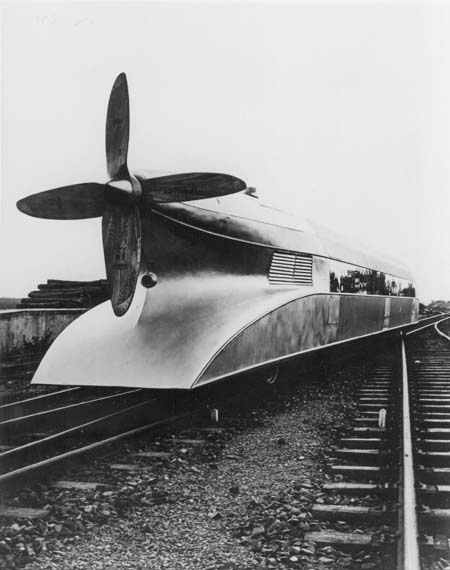
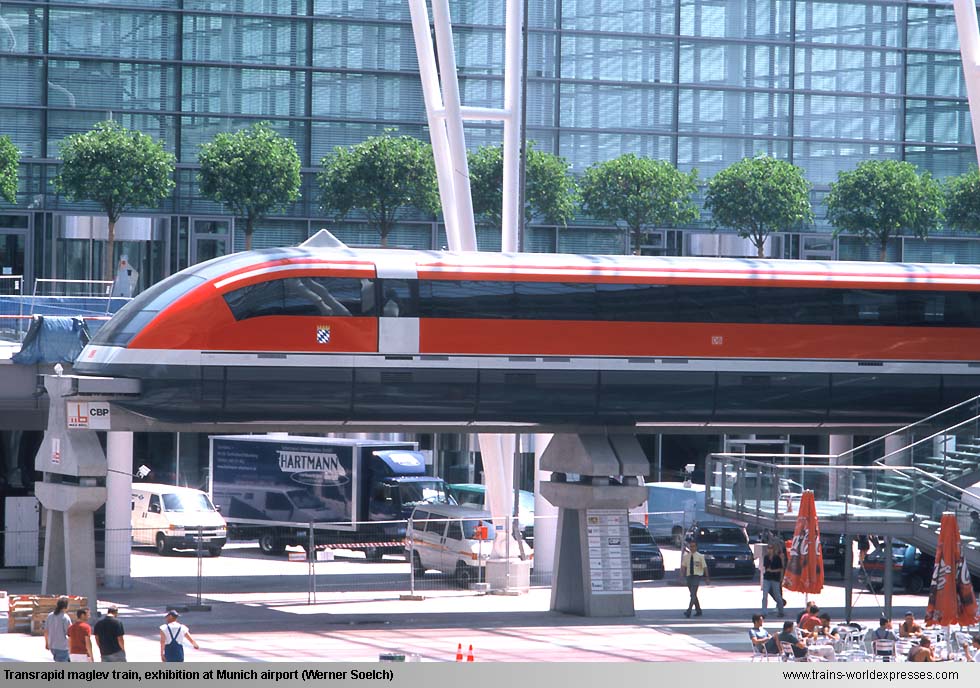
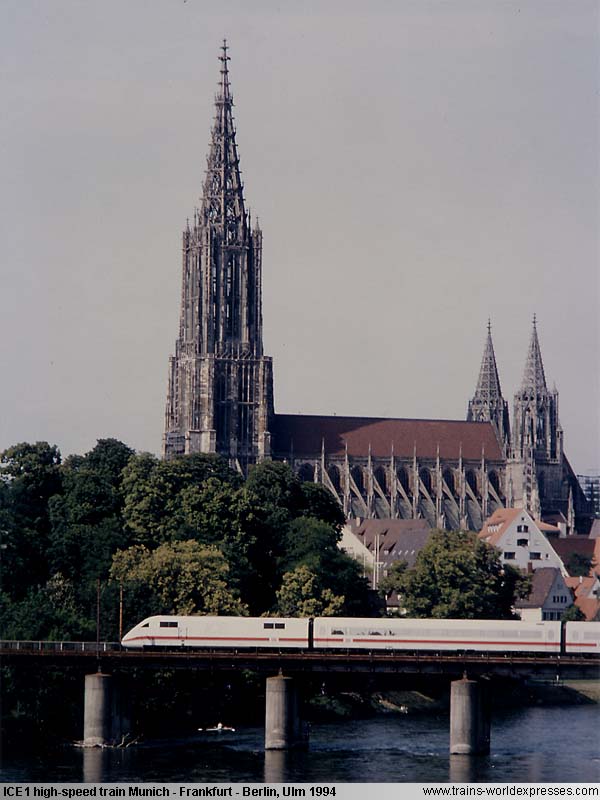
The New Railway Age A new railway age had come with the Japanese Shinkansen in 1964 - electric high-speed “no-frills”daylight trains for everybody, no longer only for the privileged ones, now in combination with innovative booking systems. Where true high-speed lines have been built, they were immediately victorious over short-haul air traffic. High-speed technology had been anticipated already in 1891 by engineer Karl Zipernowsky, who proposed an electrified railway Vienna - Budapest for 250 km/h. Technology was tested in Germany by AEG and Siemens in 1903, when electric railcars achieved a speed around 200 km/h or 125 mph. Development was continued by German pioneer Franz Kruckenberg with his propeller-driven “Schienenzeppelin”, a test vehicle, and then with the German diesel railcar Fliegender Hamburger and the Italian electric ETR200. With the Shinkansen, Japan took leadership and from there the idea of high-speed links did spread to Europe, Asia and finally to the United States. Now “high-speed” means top speeds between c. 250 and 380 km/h and in future possibly still more in regular service on new lines. Even regional trains, often with tilting technology, may attain more than 200 km/h. North America It was North America where the commercial decline of conventional passenger trains had started, caused by the motorcar, but then more and more by the plane. In the United States passenger air transport (by RPK) had surpassed intercity rail transport in 1956 and road transport already in 1954 (according to historian R.E.G. Davies). Passenger trains of the privately-owned railways disappeared in the 1960s almost completely, except some famous expresses, saved in 1971 by subsidized Amtrak. Also in Canada and in Alaska a few regular expresses survived as a tourist attraction. Towards the turn of the century the excellent Amtrak trains attained 22 billion passenger kilometers, compared to more than 1 trillion RPK by air. . Though the losses of the classic long-distance trains achieved not even 0.05 percent of the annual U.S. budget, the nice expresses were repeatedly menaced from being closed down, what would mean the end of a network covering the United States. High-speed developed first in the Northeast corridor with the ‘Acela’ expresses, based on French technology. In 2010 their traffic share of 65% was reported. Various other projects for high-speed lines within densely populated regions were prevented, presumably by competing industries. Nevertheless initiatives for new intercity lines arose once again under President Barack Obama, to be started in California. In March 2011 however, Railway Gazette International reported that the Republican Governor of Florida “decided to reject any federal funding for the proposed 135km high-speed line between Tampa and Orlando (…) which had been widely seen as a flagship for introducing high-speed rail in the USA.” Fortunately in 2012 Railway Gazette Intl. could report that funding for the first section of the Los Angeles – San Francisco high-speed line, promoted already by Schwarzenegger, was signed by Governor Jerry Brown. Europe In Europe after WWII the once exclusive “grand” expresses were opened by the state railways to the working-class. Dependent on low tariffs, almost all of them decayed horribly. Finally they were withdrawn one by one, after the skies had been opened up in Western Europe for tourists by charter airlines and for migrant workers by new Turkish and other carriers. Towards the turn of the century, certain international flights even with standard airlines became cheaper than journeys by train. A round trip Germany – Greece by the last expresses before they disappeared in the 90s did cost around 600 mark (300 euro), by Lufthansa out of season in the first years of the 21st century around 150 euro. European railways’ RPK, which had risen to c.300 billion (concerning the EU before extension), was based mainly on national traffic. Since WWII the state railways had been subsidized, but then a yield was achieved in some countries, in France for the first time under SNCF chairman Gallois (who changed to Airbus) and in Germany in the 21st century under DB CEO Mehdorn (who came from the aviation industry). A study, published by Railway Gazette International in 2009, stated that passengers are classifying direct connections even higher than comfort. A network of direct international trains however did no longer cover Europe. Paris had direct connections by night trains in that year with 7 among the capitals of the 25 Schengen area countries, but several countries had already started to close down uneconomic night trains. The European Timetable Conference has been abolished many years before. Italian state railways combated even with lawsuits the attempt of an international consortium to maintain the last day trains Germany – Italy (as high-ranking DB insiders reported). Technology in the most important countries concentrated on high-speed day trains, competitive on limited routes after their start in France in 1981. The TGV Sud-Est, as well as the ‘Eurostar’ London – Paris achieved immediately a traffic share of more than 60%. In Germany the start of the ICE1 had been furiously combated by some media, even with the lie that they will be parked on the sidings, but passengers have decided for the train. Finally the ICE3, with distributed power very advanced, was adapted for entering France. Extension to London initially was opposed by the competing industry with lawsuits and in Germany by some “Green” party speaker (quoted by tz, Dec.30, 2010). The Mont Cenis base tunnel line for a high-speed line from France was combatted in Italy by “militant groups of Black Blocks”, as the press reported it. And Italian state railways tried to ban the TGV Paris – Milan from entering Milano Centrale (good for the airlines). Turkey has started semi-high-speed trains and is building a network covering the country. In England the enterprise Virgin Trains of the Virgin Airlines group is an example of private initiative. The project of an up-to-date high-speed line between London, the West Midlands and Scotland however was condemned among others by the former chancellor of exchequer (The Wall Street Journal, March14, 2011). On the other hand, the journal could report: “In 2008 SNCF acquired a stake in Nuovo Trasporto Viaggiatori. It will be Europe’s first private high-speed train company that will operate a fleet of 25 trains across Italy.” SNCF chairman Guillaume Pepy was quoted, stating optimistically: “High-speed rail is all about the long term. When you build a high-speed track you build it for 70 years. That is the choice Spain, China and now Russia have made.” Russia In the communist east, the long-distance trains of the state railways RZhD were for decades in a much stronger position. Though the Soviet Union had drastic travel restrictions, it has built up a network of direct trains and sleeping-cars, extending to Western Europe, Mongolia, China and North Korea. Aeroflot’s plan around 1960 to transfer every passenger traffic over 400km from train to plane has proven unrealistic. And Aeroflot’s claimed share of 89.9% in trans-Siberian traffic already in 1973 is considered doubtful. In 2010 Railway Gazette International informed that “RZD says it has a 65.7% share in domestic long-distance passenger market”. At that time, train was still cheaper than plane. So the 0.4 billion people in ex-USSR countries are still for a while dependent on conventional trains. Nevertheless Russia targeted future with introduction of the “Sapsan”, based on German ICE technology. First the service St. Petersburg – Moscow was opened and the network has already been extended. Other Regions In certain Middle East countries, e.g. Iran, conventional trains continued competing with airlines. The few old international expresses in the Middle East however have disappeared long ago. On the other hand, daring new projects were started. The Hamarain project of Saudi Arabia could once be extended to Jordan and possibly to Turkey. About India with its more than 1.1 billion inhabitants and a conventional national rail network, officially no longer loss-making, Financial Times has written in 2008 (August23): “India’s affluent middle class is rekindling its affair with long-distance train travel, as sharp jumps in domestic airline ticket prices push many former frequent flyers back to the railways”. New railways in India were evaluated initially for freight traffic, but then also the idea of high-speed passenger traffic emerged. There is still a long way to go to become an economic powerhouse like China. Pakistan ltried to leap ahead with the project of a high-speed line Lahore – Rawalpindi. In the vast country of Australia, apart from some nice intercity expresses, a few conventional long-distance trains were maintained. Before re-organization, the latter’s annual losses of 1 billion Australian dollar (c.0.6 billion US dollar) were reported. The highly appreciated trains continued running, being a sector of the tourist industry. In New Zealand, too, passenger trains are a tourist attraction. They were almost closed down after the network had been privatized. Like in some other world regions, private owners could not maintain it and gave it back to the government. In Latin America, where the rail network never covered the whole continent, passenger trains caused losses and almost all the services were shut down, e.g. in Argentina in a rigorous way in 1993 by President Menem. Also in Mexico in the late 90s passenger trains were withdrawn, railways were privatized and freight service became profitable. In Brazil passenger trains beyond suburban services vanished, too. Around 2010 however the project of a high-speed railway Rio de Janeiro – Sao Paolo revived, being disputed in 2011. An extension to Campinas would link it with the important Sao Paolo Guarulhos airport. In Africa, the North and the South have rail networks with domestic passenger traffic, but the continent had never a continuous network. Mainly the densely populated Nile delta region of Egypt has an intensive passenger train service. Morocco has already acquired expertise from France for a high-speed line Tanger – Casablanca. In many regions of Sub-Saharan Africa however, rails have decayed and airlines are almost the only regular means of transport, though not yet for the working class. In 1978 the Economic Commission for Africa (ECA) of the UN stated that the task of air transport is not a deluxe service but “common carrier service”, at a total cost much cheaper than building a new road or rail network. Nevertheless Tanzania, Ghana, Mozambique and other countries started to renovate their, rail network, assuming a change to standard gauge. Far East High-Speed Japan is the country, were nowadays’ high-speed technology was introduced for the first time. The ‘Shinkansen’ trains attained a 50% traffic share immediately after their introduction on the new Tokyo – Osaka line in 1964. In the meantime the network was extended to cover the entire country, from the island of Kyushu in the south to Hokkaido in the north, with trains running at a speed up to 360km/h. Korea with French, than own technology and Taiwan (with Japanese train sets) followed. China is world’s new economic powerhouse - and Chinese railways achieved already in the year 2000 an RPK of 442 billion. In the 21st century the government risked even higher investment, initially utilizing technology from Japan, Germany and France, pushing forward its own development. Also fast sleeping-car train sets were introduced on routes such as Beijing - Shanghai. The high-speed service Beijing – Tianjin at a top speed of 350km/h was the sensation in 2008, followed by Beijing – Shanghai and Beijing – Hong Kong, the latter route of c.2,500km planned to be covered within 8 hours at a top speed of 380km/h. For 2020 a network of 16,000km became envisioned, “duplicating or replacing 80% of domestic airlines routes” (Railway Gazette International, Feb.2010). The crash of two bullet trains in 2011 was eagerly noticed by the media, but like the Enschede accident in Germany years before, it could not stop high-speed development. At present, Chinese high-speed trains are the fastest in the world. Unlike some other nations, China plans to take the electric energy in future from nuclear power stations, thus becoming less dependent on limited oil resources. China’s neighbour Vietnam evaluated the plan to build a high-speed line crossing the country from north to south. Proposals published in 2010 for new Chinese-built Pan Asian railways to Singapore or via Myanmar to India, a joint Chinese-Russian venture for high-speed lines and Russian Talgo trains Moscow – Berlin and Prague may open surprising aspects. Maglev Development Technologies radically different from conventional railways had been evaluated, such as the monorail, proposed in Germany in the early 20th century. After WWII it was developed there under the label Alweg. Monorail proved not always convincing. Another development was the “Aerotrain”, prop or jet powered, with air cushion technology, developed in France from 1965. Noisy and uneconomic, the project was abandoned in 1977 in favour of the TGV. Superior to any other terrestrial means of transport in consideration of ecological compatibility, quietness and speed proved the magnetic levitation or maglev technology. An idea in a form somewhat like an open Faraday cage had been published already in the 19th century in France. Realistic studies were started in 1922 by Hermann Kemper in Germany. Development continued together with aircraft designer Ludwig Boelkow in 1966 at MBB and in 1968 at Krauss-Maffei under Stefan H. Hedrich. A maglev network was evaluated for Germany in the 80s, but the government didn’t finance it. Every attempt to build a commercial maglev “Transpapid” line was prevented by provincial politics and propaganda. When a Transrapid test unit at 170km/h hit a construction vessel, it was reported as a setback, but in reality it proved the safety of maglev trains, for it did not derail, what every other train would have done. The last project in Old Europe was the Munich airport link, “successfully” combated by some press with the lie that “it makes a hell’s noise” (in reality it is the less noisy means of transport) and by the municipality with an expensive campaign, plastering the city with posters. Bavaria stopped the project, whereupon chancellor Angela Merkel was disappointed. In China however, a line with German ‘Transrapid’ technology was opened in 2002, bringing shame upon some German report, which doubted if the Chinese can build it. On December 31, 2002, the maglev train glided silently at a speed of 430km/h (267mph) from Pudong International Airport to Shanghai, German chancellor Schroeder on board during his state visit. A speed of more than 500km/h (310mph) is possible. For an extension the expected cost of $40 billion for 2,000km is an obstacle. Second country, where maglev technology was developed, is Japan. In 1995 the first test unit was built, using helium-cooled low-temperature super-conductors, targeting the future Chuo Shinkansen line. In 2011 it was decided that it should connect Tokyo with Nagoya at a speed of 500km/h. In the United States, NASA has started developing a high temperature super-conductor system. Also Korea is eager to study maglev technology. A Swiss intercity maglev proposal in the early 90s however was considered unrealistic, for this “Swissmetro” should have been a subway. A competitive passenger train network covering bigger regions, e.g. the East of the United States, would require innovative technologies. Imagine a maglev “21st Century Limited” New York – Chicago running at a speed of 300mph, or an even faster “Sonic Chief” Chicago – Los Angeles… In the USA the government had financed studies into a supersonic subterranean maglev railway already in 1971. From 1999, approval of $1 billion was reported. Later studies by Elon Musk were purely hypothetical. New superconductive technology, under development by NASA and by Airbus, could ameliorate also maglev technology. Irrespective of the technology used, electrified railways are at present the only means of transport that can be independent from the limited fossil fuel resources. And electric trains are the most ecologically-friendly means of transport. According to the well-known German magazine Der Spiegel (45/ 2012) the motorcar burns an average of 6 liter fuel per 100 passenger-kilometers, the train 2.5 liter and the bus 1.4 liter. However, the report ignored the fact that the electrified train uses energy being produced by a power station several times cleaner than by an internal combustion engine, as Newsweek has confirmed it already years before. Mainly Japan, France, Spain, Korea and now the economic superpower China demonstrated railways’ step into future. Concerning the global aspect, the above-mentioned Wall Street Journal quoted SNCF’s Guillaume Pepy, saying that “there are prospects in Russia, Saudi Arabia and California as part of U.S. President Barack Obama’s proposed $53 billion high-speed rail plan.” Estimates about the end of fossil fuel are controversial and the threat of a man-made climate catastrophe is still widely ignored – favourable to the coal, oil and gas industry. But changes must come if mankind should be saved from a catastrophe. And where is the largest population expected after fifty years? According to estimates, in China, India and Nigeria… Japan's Shinkansen high speed trains proved able to compete with air transport. And they are not only running over short distances. The “Nozomi” ultra-high speed trains Tokyo - Hakata Fukuoka cover 1180 km within 5 hours! Magnetically levitated linear-propulsion “maglev” trains with regular speeds up to 500 km/h or more than 300mph could compete with air transport even over longer distances. Its development, initiated in Germany by Hermann Kemper and Ludwig Boelkow, started in 1966 at MBB works and in 1968 at Krauss-Maffei under Stefan H. Hedrich. Japan followed soon. German politics however did not finance a maglev “Transrapid” network. Some press and “environmentalists” combated it, the motorcar industry and airlines profited. A proposed Berlin - Hamburg link was rejected by German railways and minority parties. One argument against the Transrapid was the existing international European train network, but then mainly Germany stopped most international services. In the German province of Nordrhein-Westfalen a regional Transrapid was prevented by the local government. German maglev technology was first used in future superpower China, where in 2002 the Shanghai Pudong maglev airport link was successfully completed. The train glided silently at 430 km/h (267 mph) with German chancellor Schroeder aboard during his state visit and already a speed of 500 km/h was achieved. The Munich Transrapid airport link for 350km/h was the only remaining maglev project in Europe, but in 2008 it was stopped by the government after leftist parties, supported by some popular press, started an expensive campaign against that most environment-friendly means of transport. It was reminiscent of the end of the Alweg monorail project at Los Angeles many years ago, caused by the American motorcar industry. Japan continued to develop maglev technology independently, maglev project studies were started also in the USA and the last hope may be based on China or possibly Korea. The battle against the Munich Transrapid however meant possibly the end of every illusion about a new innovative means of passenger transport for a long time. Air traffic is the winner.  ICE test unit running Munich - Frankfurt parallel to "Blauer Enzian" exceptionally on Jan.12, 1986 (WS) 
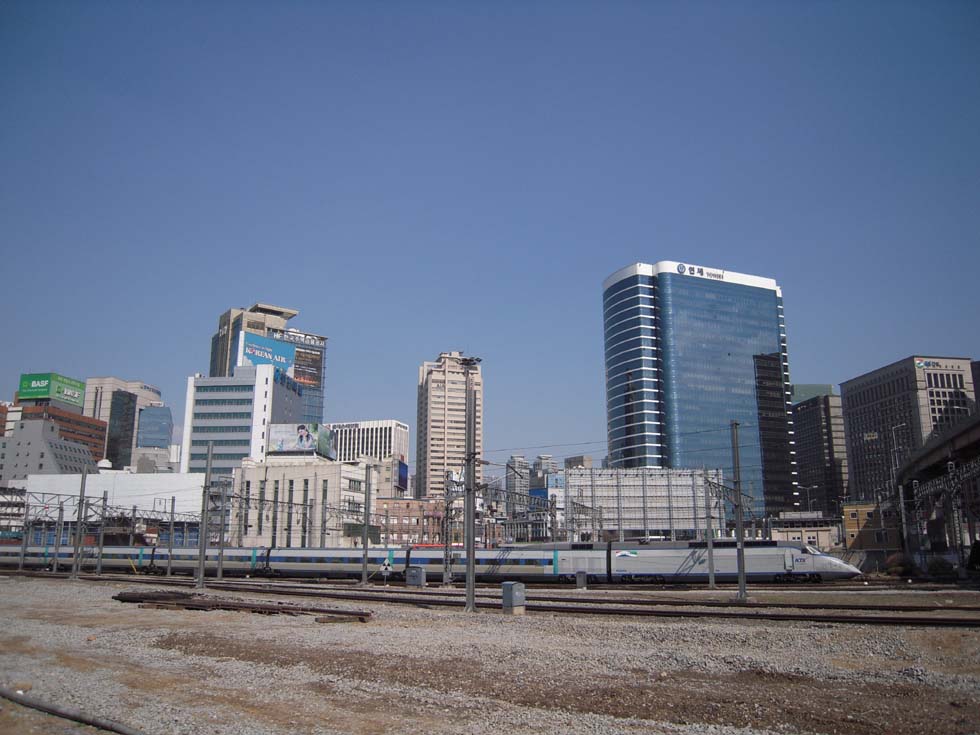 KTX-I high-speed train, Seoul 2011 (WS)
|